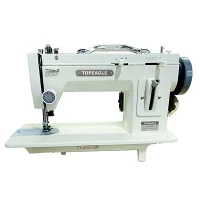
Handling skipped stitches on different fabrics requires specific techniques:
Dealing with Skipped Stitches on Extra-Thick Sections of Down Fabric
When sewing down fabric with added vacuum cotton or down, creating a thickness of 0.7-1.1 cm, the needle and thread may struggle to form a proper stitch, leading to skipped stitches. To address this, first solve the feed issue by switching to a feed dog designed for heavy fabrics. Enlarge the needle plate's needle hole and adjust the feed dog cam accordingly.
Adjustment standards:
The feed dog teeth should reach their highest position, and the needle tip should be within the needle plate's needle hole.
Adjust the needle bar height substantially. The needle bar height should be set to drop 0.1 cm below the third line on the needle bar scale when it reaches the needle bar's lowest point. This utilizes the extended needle bar travel principle to complete the stitching.
Timing between the needle and the hook also changes. Adjust the angle when the needle bar rises from its lowest point to the first scale line. The angle adjustment values should be consistent with the above. Increase the presser foot pressure because thick fabrics can cause friction and heat, making it challenging to form stitches. If necessary, use silicone oil at the thread passage to solve the problem.
Dealing with Skipped Stitches on Unwashed Silk Fabric with Two Layers
Unwashed silk fabric can be stiff and hard before sandwashing, causing the needle and thread to struggle to form a proper stitch when sewing two layers of fabric, resulting in skipped stitches. Check if the needle bar is worn or has gaps. Examine the condition and standards of the shuttle tip, as it is a critical component for forming stitches. It must not have any burrs or dull tips. If any issues are found, promptly use a diamond file or emery cloth to achieve the required standards before adjusting the angle.
Check the needle bar height; the standard is that the needle bar scale line should be on the second line when the needle bar is at its lowest point. Adjust the angle between the needle and the shuttle when the needle bar rises to the first scale line. The shuttle tip should be 1.1-1.5 cm above the needle hole, with a lateral gap of 0.02-0.05 cm. The feed mechanism is crucial; first, check if the feed dog cam is set correctly. Since you're sewing thin fabric, the teeth should be lower, so adjust the feed dog cam accordingly.
Dealing with Skipped Stitches on Sandwashed Silk Fabric when Sewing Different Layers
Sandwashed silk fabric becomes soft after washing, making it difficult for the needle and thread to form proper stitches while sewing different layers. This can lead to gaps under the presser foot at the seams between layers, preventing the formation of proper stitches and resulting in skipped stitches. In this case, check if there are gaps in the needle bar. Examine the shuttle tip for burrs or sharp edges.
Adjust the needle bar height based on the thickness of the layers, with the third line on the needle bar scale as the reference. The angle adjustment should occur when rising from the third line to the first scale line. Ensure that the needle plate's needle hole is standard. If you're using a medium-speed lockstitch machine, grind down the rear of the presser foot slightly to facilitate smooth fabric feeding.
Dealing with Poor Fabric Feeding Leading to Skipped Stitches when Sewing Leather
When sewing leather, fabric stiffness can lead to poor fabric feeding, resulting in skipped stitches. You can follow the methods used for thick fabrics described earlier. However, addressing fabric feeding issues is slightly different. Using a nylon presser foot can help with smoother fabric feeding. You can also use silicone oil at the sewing area for leather items.
Dealing with Breakage, Tangling, and Skipped Stitches When Sewing Denim with Thick Thread
When sewing denim with thick thread, forming proper stitches can be challenging, and thick thread may not release from the shuttle's positioning hook, causing breakage, tangling, and skipped stitches. In addition to the methods mentioned for thick fabrics, there are some differences. Since thick thread is used, it may be necessary to modify and grind the positioning hook of the shuttle during maintenance to ensure that the thick thread releases smoothly. It's also advisable to select a shuttle with minimal wear and tear.
These techniques and adjustments will help resolve skipped stitch issues on different fabrics in the sewing machine industry.