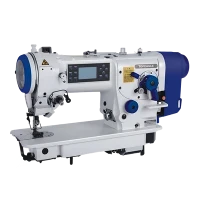
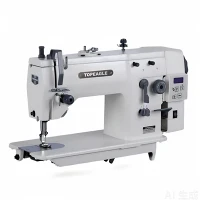
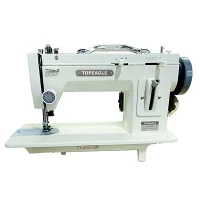
Top-and-bottom feed and roller-foot feed are the two main feed methods used in heavy-duty industrial sewing machines. Let's analyze the applicable machine ranges for each feed method.
First, let's clarify the working principles of the two feed methods:
1. Synchronized feed of the Feed dog and presser foot
· Working Principle: The feed dog, the core component of the feed mechanism on a sewing machine, typically consists of two or three rows of teeth. These teeth are set at angles between 45 and 60 degrees, and the tips are blunted to prevent snagging the fabric. During the sewing process, the feed dog follows a carefully designed motion path. When the needle has finished sewing and exited the material, the feed dog rises to a height above the needle plate. This height is controlled within a range of 0.75-1.2mm. The feed dog then moves forward, working in conjunction with the presser foot to precisely clamp the material to the desired stitch length. After feed is complete, the feed dog returns to its original position, and the needle moves downward, completing a stitch.
This is the most classic and common feed method used in industrial lockstitch sewing machines. The lower feed dogs move in an elliptical or rectangular motion (upward, downward, and backward) beneath the needle plate, pushing the fabric forward. The presser foot holds the fabric in place, providing sufficient friction to prevent it from lifting with the needle and assisting the lower feed dogs in pushing the fabric forward. However, the traditional presser foot itself is stationary.
· What does "synchronous feeding" mean? "Synchronous feeding" is a confusing concept. It usually refers to an improved version: synchronized needle, feed dog, and presser foot. In this mode, the presser foot also participates in the feeding motion, moving back and forth in sync with the lower feed dogs, achieving true coordinated feeding and significantly improving feeding efficiency.

2. Upper and Lower Roller Feeding
· Working Principle: This method completely eliminates the traditional lower feed dogs and needle plate. Instead, it uses upper and lower rubber or polyurethane rollers to clamp the fabric. Through a sophisticated mechanical structure, these rollers rotate synchronously, moving the fabric forward smoothly like a conveyor belt. The feed length and speed are determined by the roller speed.
Comparison Summary Table
Features: Synchronous Feeding of Feed dog and Presser Foot; Upper and Lower Roller Feed; Pros and Cons Analysis
Feeding Principle: Feed dog push, presser foot compresses (or moves in tandem); Dual rollers clamp and pull. Roller feed is a pull-type feed, which is gentler; tooth feed is a push-type feed, which may cause squeezing.
Fabric Adaptability: Highly versatile. By changing the teeth and presser foot, it can accommodate most fabrics, from gauze to thick canvas. Poor. Primarily suitable for medium-thickness fabrics with smooth surfaces (such as shirting, silk, and synthetic fibers). Less effective with elastic, sticky, or very thick or thin fabrics. Teeth feed excels in versatility. Roller feed has significant limitations.
Preventing Slippage/Layering: The standard type is poor, prone to shifting (layering) between the upper and lower layers of fabric. The triple-synchronous type offers significant improvements and is one of the ultimate solutions for preventing layering. Excellent. Because the upper and lower rollers rotate completely synchronously, the upper and lower layers of fabric are firmly clamped and conveyed together, virtually eliminating layering. In terms of slip prevention, standard roller feeds are better than triple-synchronized feeds, and traditional tooth feeds are better.
Fabric damage: Possible. Hard metal teeth may leave marks or punctures on delicate fabrics (such as leather and silk). Extremely low risk. The soft rubber roller surface provides even pressure, making it ideal for delicate, smooth fabrics without leaving any marks. Roller feed offers a clear advantage in protecting fabrics.
Stitch quality: Excellent, with mature and stable technology. Thanks to the extremely smooth, vibration-free feed, stitch lengths are uniform and beautiful, and sewing speeds can be very stable. Roller feed generally offers superior and more stable stitch quality.
Operational ease: Adjusting the tooth height and presser foot pressure according to the fabric requires experience. It's very simple. Generally, you can simply lower the presser foot and start sewing, without complex adjustments. Roller feed is easier to operate and requires less skilled workers.
Maintenance and cost: The structure is mature, parts are common, and maintenance costs are low. The teeth and presser foot are consumable parts and require regular replacement. The structure is relatively complex, resulting in high manufacturing costs. Rollers are consumable and require replacement after extended use, making them highly specialized. Dog feeds offer advantages in terms of cost and ease of maintenance.
Typical Applications: Most sewing applications: clothing, luggage, home furnishings, and more. Triple-speed feeders are commonly used for areas such as high-end shirts and suits where smooth, level cuts are required. Specialty Sewing Applications: 1. High-end shirts (front plackets and collars); 2. Thin materials such as silk and chiffon; 3. Leather products (to avoid creasing); 4. Quilting; 5. Some automated sewing units. Dog feeds are the mainstream; roller feeds are specialized for specific needs.
Conclusion and Selection Recommendations
· Synchronous feeding of the lower dog and presser foot (especially the triple-speed feeder) is the king of versatility. It can handle nearly any imaginable fabric and sewing task, and is currently the undisputed mainstream in the global sewing industry. Choose this machine if you need a versatile machine or your product line is complex and varied. The triple-speed version is the perfect solution for solving the problem of level cuts on high-end fabrics. A top-down roller feed is a specialist. It excels in its specific areas (preventing ply, protecting fabric, sewing extremely delicate or smooth fabrics, and requiring the finest seams). If your production focuses on specific areas like high-end shirting, silk, and leather, and you demand the highest sewing quality, a roller feeder is the perfect choice. However, it cannot replace a general-purpose sewing machine.
Summery
If you're looking for versatility, cost-effectiveness, and the ability to handle a wide range of fabrics, choose a synchronized feeder with Feed dog and presser foot.
If you're looking for the ultimate in quality, handling specific delicate fabrics, and achieving zero ply, choose a top-down roller feeder.
In modern factories, these two types of equipment often coexist in a complementary manner, serving different production lines and processes to achieve the highest efficiency and quality.
If you want to buy a walking foot sewing machine or roller feed sewing machine, please contact us.
Related searches:
Top and bottom feed sewing machine, walking foot sewing machine, roller feed sewing machine, top and bottom roller feed sewing machine, flat bed roller feed sewing machine, roller feed shoe sewing machine, walking foot machine, Walking foot leather machine. walking foot leather sewing machine.