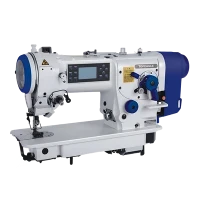
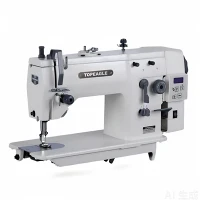
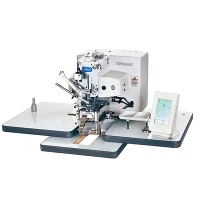
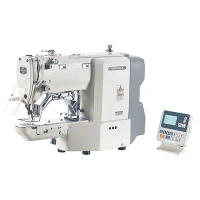
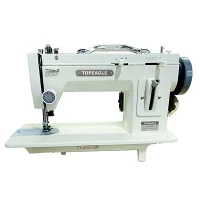
Common sewing techniques include plain stitch sewing, chain stitch sewing, overlock sewing, and coverstitch sewing. Specialized sewing techniques include reinforcement (basting) sewing, button sewing, eyelet sewing, and embroidery sewing.

Plain Stitch Sewing Technique
Plain stitch sewing is the most basic sewing technique, used to join fabric pieces together. The lockstitch formed by this technique is characterized by its strong hold, good security, and minimal elasticity. For woven fabrics, various types of straight-stitch machines, such as flatbed sewing machines (for flat-seam fabrics), cylinder-bed sewing machines (for sewing curved fabrics), and post-bed sewing machines (for sewing small curved and special-shaped fabrics), are suitable choices based on the sewing product's process requirements.
Depending on the fabric type, different feed methods can be chosen for the straight-stitch sewing machine, including top and bottom feed, top and bottom differential feed, bottom differential feed, and needle feed. Additionally, for different stitch counts, double-needle straight-stitch machines can be chosen. The choice of the appropriate straight-stitch machine based on the sewing technique is essential to achieve satisfactory sewing results.
Chain Stitch Sewing Technique
Chain stitch sewing is a common sewing technique that utilizes the stretch characteristics of the chain stitch. It is often used for sewing knit fabrics. Due to the continuous supply of the lower thread similar to the upper thread, it is also used for sewing woven fabrics. The single-thread chain stitch and two-thread chain stitch are easy to disassemble, making them suitable for sewing packaging bags. Chain stitch sewing is widely used in various sewing techniques.
Overlock Sewing Technique (Coverstitch Sewing)
The overlock sewing technique is a common sewing method that creates a specialized form of the chain stitch. It is used for finishing the raw edges of fabric pieces after cutting. Overlock machines have various types, such as three-thread overlock, four-thread overlock, five-thread overlock, etc. These machines not only finish the raw edges but also join fabric pieces together. Due to the stretch characteristics of the chain stitch, overlock machines are commonly used for sewing knit fabrics.
Coverstitch sewing machines are also used for overlock sewing and are available in various models like two-needle three-thread coverstitch, three-needle four-thread coverstitch, four-needle five-thread coverstitch, and more. Sewing factories need to select the appropriate overlock machine based on different sewing techniques.
Reinforcement (Basting) Sewing Technique
The reinforcement sewing technique utilizes the lockstitch and is generally used at the beginning or end of a seam to prevent seam openings. Mechanically controlled reinforcement sewing machines can only sew one type of reinforcement stitch (e.g., 28-stitch reinforcement). However, with the development of computer-controlled reinforcement sewing machines, any number of stitches can be programmed.
In recent years, reinforcement sewing has become one of the fastest-growing sewing techniques, particularly in pattern sewing. The machines, like pattern machines (template machines), have evolved into a large series. When selecting machine models, not only the number of reinforcement stitches but also the size of the pattern sewing frame needs to be considered.
Button Sewing Technique
The button sewing technique employs both lockstitch and chain stitch. As such, the choice of sewing machine includes chain-stitch button sewing machines and lockstitch button sewing machines. Button sewing involves reinforcing the button in the garment by sewing it through two holes repeatedly.
Common buttons include flat buttons, shank buttons, and toggle buttons, each with variations like two-hole flat buttons and four-hole flat buttons. Depending on the button type, sewing machines perform one or two rounds of reinforcement stitches. Shank buttons are usually used for thicker fabric on garment plackets and cuffs, requiring two rounds of reinforcement stitches. When selecting sewing machines, the button type determines the machine type.
Eyelet Sewing Technique
The eyelet sewing technique uses both lockstitch and chain stitch, forming eyelets with various curved and twisted stitching patterns. Thus, the sewing machine options include lockstitch eyelet sewing machines (flat-head eyelet machines) and chain-stitch eyelet sewing machines (round-head eyelet machines).
Lockstitch eyelet sewing machines are typically used for sewing thin fabrics, while chain-stitch eyelet sewing machines are suitable for sewing thick fabrics.
Embroidery Sewing Technique
Embroidery sewing techniques use both lockstitch and chain stitch. Various forms of embroidery sewing machines and pattern sewing machines are available. With the continuous development of auxiliary devices and decorative accessories, various embroidery sewing requirements can be fulfilled, such as gold thread embroidery, cord embroidery, and ribbon embroidery. The selection of embroidery machine models depends on the characteristics of the embroidery design.