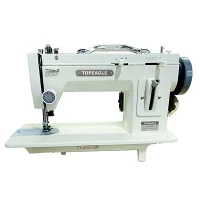
Description
The history of industrial machines has played a crucial role in transforming various industries, from textiles to manufacturing. Among these machines, the over edging machine stands as a vital tool in the textile industry, enabling the efficient finishing of fabric edges.
Early Innovations of the Nineteenth Century:
The over-edging machine's origins can be found in the middle of the century, when the textile industry was experiencing a boom. The demand for fabrics created a need for more effective production and finishing techniques. Edge finishing during this time was primarily accomplished by hand sewing, which was labor- and time-intensive.
The first machines were manual, foot-operated devices that mimicked the hand-sewing technique. They were basic but offered a significant improvement in speed and quality compared to hand-sewing. These early innovations marked the birth of the over-edging machine and laid the foundation for future developments.
Industrial Revolution and Automation (Late 19th to Early 20th Century):
The Industrial Revolution brought about a wave of technological advancements, and the textile industry was no exception. As the demand for textiles soared, manufacturers sought ways to increase productivity. In the late 19th and early 20th centuries, mechanical machines were introduced, replacing the manual foot-operated ones.
These early mechanical versions were powered by steam engines and later by electric motors. They enabled continuous seam stitching and significantly enhanced the speed and efficiency of fabric edge finishing. As automation became more prevalent, these machines were integrated into larger production lines, transforming the textile industry's capabilities.
Specialized over edging machine (Mid-20th Century):
As technology progressed, specialized over-edging machines emerged to cater to different fabrics and specific edge finishing requirements. The development of serger machines, a type of over-edging machine, gained popularity in the sewing industry. Sergers not only finished raw edges but also trimmed excess fabric simultaneously, producing neat and professional results.
Additionally, advancements in automation and computerization led to the incorporation of electronic controls and programmable settings . These innovations offered greater precision, flexibility, and customization options, making them indispensable tools for modern textile manufacturers.
Modern Innovations and Digitalization (Late 20th Century to Present):
In recent decades, the over-edging machine has undergone further advancements due to the integration of digital technology. Computer Numerical Control (CNC) and robotics have revolutionized the manufacturing process, allowing for more complex designs and higher levels of automation.
Today's machines are equipped with user-friendly interfaces, advanced sensors, and intelligent systems that optimize efficiency and minimize errors. The machines can handle a wide range of fabrics, from delicate silk to heavy denim, with ease and precision. Additionally, eco-friendly features have been incorporated to reduce energy consumption and waste.
Conclusion:
The history of the over edging machine is a testament to the power of innovation in revolutionizing industries. As technology continues to progress, we can only imagine the further enhancements that await this vital tool, shaping the future of fabric edge finishing.