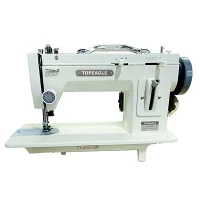
Thread take-up lever
The main body and core of sewing equipment, taking a flat-bed sewing machine as an example, no matter how complex and precise its mechanism is, as long as it uses needle and thread to sew the sewing material, it is inseparable from the joint movement of the four basic mechanisms: needle bar mechanism, thread hook mechanism, thread take-up mechanism, and feed mechanism.
Among the four mechanisms, the mechanism that transports, recycles, and tightens the needle and thread is called the thread take-up mechanism. The thread take-up lever is responsible for collecting and releasing the surface thread in each sewing work cycle and cooperates with the cloth feeding mechanism to complete the formation of sewing stitches. The thread take-up spring, thread clamp, and thread slow hook are all subordinate to the thread take-up mechanism. Properly adjusting the tension and thread collection accessories is an important condition for maintaining good stitches.
The working characteristic of the thread take-up mechanism lies in the up and down movement of the thread take-up rod hole. When the thread take-up rod moves downward, it supplies thread to the descending needle, and when the rotary shuttle hooks the upper thread, it supplies the upper thread to the rotary shuttle until the upper thread ends after passing the shuttle frame. When the thread take-up rod moves upward, it is responsible for taking the upper thread off the shuttle frame and tightening the stitches formed in the sewing material to form a firm stitch, and pulling out the upper thread from the thread ball to prepare for the formation of the next stitch.
The thread take-up mechanism is divided into:
1. Cam thread take-up mechanism. A mechanism in which the thread take-up rod moves by the cam.
2. Connecting rod thread take-up mechanism. A mechanism in which the thread take-up rod moves by the four-bar mechanism. The thread take-up rod is the connecting rod of the four-bar mechanism.
3. Sliding rod thread take-up mechanism. A mechanism in which the thread take-up rod moves by the crank sliding rod mechanism. The thread take-up rod is the guide rod of the four-bar mechanism.
4. Rotating thread take-up mechanism. A mechanism that uses one or two circular disks or other shaped components equipped with thread take-up pins to perform thread take-up movement by rotating motion.
5. Needle bar thread take-up mechanism. A thread passing or clamping device fixed to the needle bar, or a thread take-up rod mechanism directly fixed to the needle bar.
In industrial sewing machines, connecting rod thread take-up and needle bar thread take-up are generally the most common. There are two ways to take up the thread: one is to tighten the previous coil before inserting the needle; the other is to tighten it using the tension device of the take-up device when withdrawing the needle. The first tightening method is used on overlock machines or interlock machines (including double-thread chain sewing machines), and the second tightening method is used on flat-bed sewing machines. The stitches required by the needle for the second thread entry come from two aspects: one is obtained when tightening the previous stitch, and the other is to extract it from the thread ball after overcoming the pressure of the tension regulator. In general, the stroke and movement trajectory of the thread take-up rod are relatively fixed. Due to its subordinate status, it is determined that the relevant dimensions of the mechanism are unlikely to be adjusted, and it should be manufactured and installed strictly in accordance with the positioning requirements.
The thread take-up mechanism of the flat-bed sewing machine was originally designed with a cam mechanism, a connecting rod mechanism, etc. Since the rods of the connecting rod mechanism are all low-pair connected, there are many advantages, especially reducing the thread breakage rate of cotton thread. Therefore, the current industrial flat-bed sewing machines all use a connecting rod thread take-up mechanism. The four-link thread take-up mechanism of the current industrial sewing machine mainly prevents the feed dog from stretching the thread segment and loosening the suture when feeding the sewing material forward, so that the machine needle reduces the interference force when piercing the sewing material, and completes the appropriate adjustment of the thread amount of the stitches by conveying and tightening the suture to ensure the correct position of the needle force.
According to the working principle of the sewing machine, there are strict time requirements for the movement coordination of the thread take-up rod, the machine needle and the shuttle. In particular, the thread take-up rod must be very accurate and coordinated with the movements of the various mechanisms of the sewing machine. Otherwise, the sewing effect will be affected at the least, and faults such as "stitch skipping" and "thread breakage" will be caused, and it will not work at the worst. Therefore, the manufacturing process of the thread take-up rod is required to be high.
2 Rotary shuttle, swing shuttle
> Rotary shuttle
Among sewing equipment, the most common sewing machine is the lockstitch sewing machine. Most of these sewing machines use a rotary shuttle, which hooks the thread loop with its shuttle tip, expands the thread loop, and guides the thread loop around the shuttle core to form a lockstitch. The rotary shuttle is an important part of the sewing machine. If the electronic control is the brain of the sewing machine, then the rotary shuttle is the heart of the sewing machine. The rotary shuttle consists of a shuttle bed, a rotary shuttle skin, a rotary shuttle plate, and a rotary shuttle frame.
The working principle of the rotary shuttle is that after the needle rises a certain distance, the shuttle tip of the rotary shuttle bed begins to hook into the thread loop. After the shuttle tip hooks the thread loop, it continues to rotate. When the thread loop is sent to the guide rail of the rotary shuttle frame, the thread loop is hooked by the thread dividing hook of the shuttle frame. At this time, the machine needle should rise about 2mm from the lower limit position. The thread dividing hook on the rotary shuttle frame should leave time for the end of the thread loop to move to the back of the guide rail when the thread loop is about to approach. The thread dividing hook and the axis of the needle movement are about 50°. The thread loop is hooked at 45° from the upper convex surface of the outer frame of the shuttle bed shuttle tip, and it continues to rotate. The end of the thread loop is hooked on the thread dividing hook. In order to make the thread loop slide smoothly onto the surface of the shuttle frame, the bevel at the tail of the wire guide plate pushes the thread head of the thread loop outward, and the back of the thread loop is hooked by the thread dividing hook of the shuttle frame and slides to the bottom of the shuttle frame. At this moment, the machine needle withdraws from the rotary shuttle mechanism.
Since the thread passing part of the shuttle frame is very smooth, the thread loop can slide out smoothly from the bottom of the shuttle frame. When the shuttle tip turns 180°, the thread take-up rod rises and collects the remaining thread sent down by the thread take-up rod. The shuttle tip hooks the thread loop and continues to rotate. The front half of the thread loop is under the wire guide plate. After passing through the 45° inclined surface of the outer frame convex surface, the edge of the moving wire guide plate gradually rises above the shuttle frame, pushing the front half of the thread loop outward. The back half of the thread loop is hooked by the shuttle frame wire splitting hook, and the thread loop is separated from front to back. Finally, the front and back of the thread loop are put through the shuttle frame, and the bottom line is put in the middle. The thread loop is tightened by the thread take-up rod to form a stitch.
The rotary shuttle is installed on the lower shaft of the sewing machine. The inner shuttle is fixed and the outer shuttle rotates with the shaft. The speed can reach 10,000 revolutions per minute, that is, about 167 revolutions per second. In one minute, 5,000 joints can be sewn (two turns to form a thread knot), and the distance between the thread knots is generally about 1 mm, sometimes even up to 0.7 mm, and the thread cannot break, jump or wrinkle. In view of the characteristics of rotary shuttle processing, Deying has improved the precision, durability and stability of the product by optimizing the process technology and adopting advanced equipment, and also improved production efficiency. The quality of some rotary shuttles even surpasses that of Japanese rotary shuttles.
A small rotary shuttle, with a radius of no more than 2cm, is a complex process that requires more than 250 processes to complete. As the "heart" of the sewing machine, it directly determines the sewing effect. Therefore, the quality of the sewing machine has very high requirements for the quality of the rotary shuttle. Among them, the polishing of the rotary shuttle is a very important part of the rotary shuttle production. In the past, only manual polishing was done. In recent years, manufacturers of rotary shuttle parts have begun to use equipment to replace manual polishing, so as to achieve the effects of deburring, chamfering, deoxidation, rust removal, grinding and polishing, precision polishing, mirror polishing, etc. of rotary shuttle parts such as rotary shuttle, shuttle case, dethreading hook, shuttle frame, bobbin, and bobbin sleeve.
> Swing shuttle
The swing shuttle in the lockstitch sewing machine is driven by a semi-rotating mechanism, and the swing shuttle hooks the needle thread loop and passes through the swing shuttle and its bobbin sleeve to interweave with the shuttle thread to form a lockstitch mechanism. When it comes to the shuttle, the rotary hook is indispensable. Both parts are for the needle to hook the thread and the bottom line together. Both the shuttle and the rotary hook are for this purpose, but the design is different. Comparing the shuttle and the rotary hook together can also better introduce the shuttle.
The principle of the rotary hook to form a trace is basically the same as that of the shuttle, but its process and method of forming a trace are different from those of the shuttle. The rotary hook rotates at a constant angular velocity, while the shuttle makes a non-constant reciprocating swing motion; in the machine needle's up and down reciprocating motion (the main shaft rotates one circle), the rotary hook rotates at a constant angular velocity for two weeks, while the shuttle swings back and forth once; the shuttle's shuttle frame is fixed, and the shuttle bed is rotating. It is the shuttle bed tip that hooks the thread loop, and the shuttle frame hook is used to divide the thread, so that it passes around the shuttle core sleeve and the bottom and top of the shuttle frame, and the thread is taken off from the shuttle board head to form a thread loop.
3 Axis
Industrial sewing machines are mainly a complete system composed of four moving parts. The front end is the piercing part, which uses the machine needle to pierce the sewing material and then gradually tighten it to form a coil. The thread picking part is the machine head piercing part that continuously supplies the thread and can be quickly retracted when the coil is recovered. The thread hook part uses the threads on the front end of the rotary hook shaft to tie each other before starting to work. The cloth feeding part is responsible for quickly supplying sewing materials to the machine head after completing a complete sewing work. The presser foot part is used to press the sewing material and change the spacing of the stitches. These are all coordinated and synchronized movements between the mechanical mechanisms of the sewing machine to ensure that the sewing machine can successfully complete the sewing work. The movement of these mechanisms requires a part to be completed, that is, the axis.
According to the type of shaft required by different models of sewing machines, they can be divided into straight shafts and crankshafts. Straight shafts are mostly used in lockstitch machines, and crankshafts are mostly used in overlock machines and interlock machines. According to the function of the shaft, it can be divided into upper shaft, lower shaft and vertical shaft. Taking the lockstitch machine as an example, the upper shaft of the lockstitch machine drives the needle bar mechanism and the thread take-up mechanism to move, the lower shaft drives the thread take-up mechanism centered on the rotary shuttle, and the vertical shaft plays the role of connecting the upper and lower shafts.
Topeagle has a strong technical force, the company's customers cover the whole country and are exported to foreign countries and all over China. Welcome to contact us at sale@eagleco.cn.