1. Function of the cutter mechanism
The characteristic of the stitch of the overlock sewing machine is that it is sewn along the right edge of the sewing material. The straight needle pierces the material and the upper and lower curved needles cooperate to hook the thread to form a 500-type stitch covering the edge of the sewing material. In order to obtain a neat stitch appearance, all overlock sewing machines are equipped with a pair of up and down moving cutter groups to cut the sewing material so that the sewing material has a neat edge. In this way, the formation of the stitch can be guaranteed to be of excellent quality and excellent stability during sewing. The position of the cutter group is on the right side of the overlock sewing machine needle, as shown in the red circle in the middle left of Figure 1.
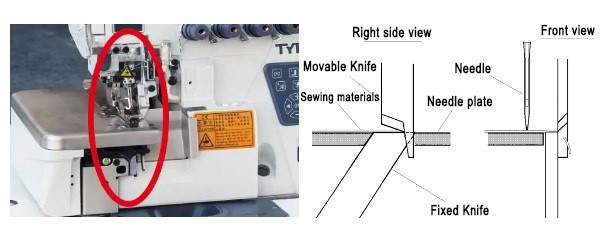
Figure 1: Overlock machine cutting knife assembly
2. Composition and operation principle of the cutting mechanism
The cutting knife group of the overlock sewing machine consists of a moving knife and a fixed knife, which are installed on the right side in front of the needle movement center. The distance between the cutting line of the cutting knife group and the needle center determines the width of the overlock stitch. Usually, the fixed knife is installed at the bottom of the needle plate, and the fixed knife blade is flush with the needle plate plane; the moving knife is installed on the moving knife holder at the top of the needle plate, as shown in the red circle in the left figure of Figure 1. The moving knife swings the moving knife holder through the transmission mechanism to drive the moving knife to reciprocate up and down. When the moving knife falls, it engages with the fixed knife to cut the sewing material, as shown in Figure 2.
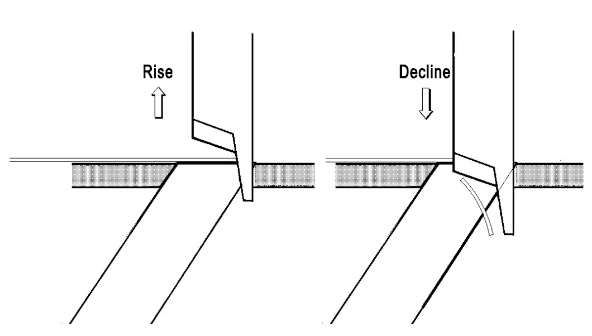
Figure 2: Cutting process of the overlock sewing machine cutting unit
The cutter transmission mechanism of the overlock sewing machine is relatively complex (as shown in Figure 3), and most of the mechanisms are inside the casing, with only a small amount of mechanisms exposed. Its working principle is described as follows:
The cutter driving force comes from the main shaft. When the main shaft 10 rotates clockwise, it drives the movable knife connecting rod assembly 9 to move up and down through the cam 8; the upper end of the movable knife connecting rod 9 is connected to the movable knife crank 12, so that the movable knife shaft 13 swings, and the left end of the movable knife shaft 13 drives the movable knife holder 14 to make the movable knife 16 (the movable blade is fixed on the movable knife holder through the movable knife seat) swing up and down; under the continuous rotation of the main shaft, the movable knife 16 will form a continuous up and down movement, meshing with the fixed knife 5 installed below, and cooperate with each other to achieve the effect of cutting the sewing material, as shown in Figure 3.
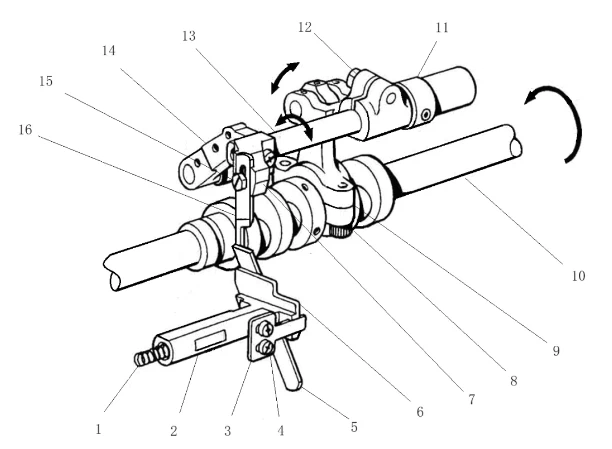
Figure 3: Cutting knife mechanism
1-spring 2-fixed knife seat 3-fixed knife pressure plate 4-fixed knife pressure plate fixing screw 5-fixed knife blade 6-fixed knife seat 7-moable knife seat 8-cutter cam 9-moable knife connecting rod assembly 10-spindle 11-cutter shaft tightening ring 12-moable knife crank 13-moable knife shaft 14-moable knife holder 15-moable knife fixing screw 16-moable knife blade
In order to facilitate installation and adjustment, the cutters are installed on the adjustable position of the cutter seat by means of a pressure plate or screws, and can be easily adjusted in height and left and right directions. The cutter group consists of a moving cutter and a fixed cutter. The moving and fixed cutters are both thin sheets made of high-hardness steel. Some moving cutter heads are inlaid with super-hard alloy steel, which greatly improves the hardness and wear resistance of the moving cutter. Usually, the hardness of the moving cutter is greater than that of the fixed cutter, as shown in Figure 4. The shape of the moving cutter blade is relatively complex. The slender shape of the moving cutter head is to provide reliable guidance during movement to avoid direct collision between the moving and fixed cutter blades. The long groove at the tail is used to fix the cutter blade with screws and adjust the height.

Figure 4: Shape and structure of the cutter of the overlock sewing machine
3. Adjustment requirements for cutter coordination
In order to achieve good cutting effect in high-speed sewing, the cutter mechanism (cutting mechanism) of the overlock sewing machine requires the adjustment of the movable and fixed knives. The following are the adjustment requirements.
1. The upper and lower coordination must be "overlapped":
First, the height of the fixed knife, the blade surface is flush with the plane on the needle plate, and the front and back of the blade must be parallel to the needle plate.
Next is the height of the movable knife. When the hand wheel is rotated to lower the movable knife to the lowest point, the movable knife blade should have a certain overlap with the fixed knife blade. The adjustment range is between 0.5~1.0mm. If the overlap is too small, it is easy to cause the sewing material to be cut or "broken silk" problems. If the overlap is too large, it is easy to cause problems such as accelerated wear of the cutter, reduced opening range of the movable knife, and increased machine load.
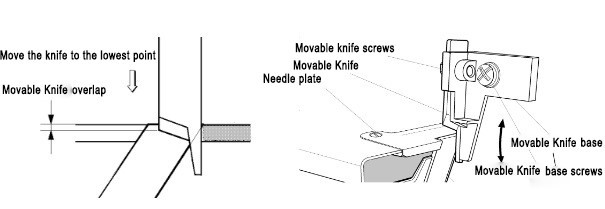
Figure 5:Cutting knife overlap
Method for adjusting the upper and lower positions of the movable knife: Turn the hand wheel to bring the movable knife to the lowest point, loosen the movable knife screw, move the movable knife blade up and down to the appropriate range, and finally tighten the movable knife screw, as shown in Figure 5.
2. The horizontal fit must be close
The horizontal fit of the moving fixed knife must be "close" to achieve a good cutting effect. Figure 6 on the left is a diagram of the position adjustment of the overlocking motorized fixed knife for reference when adjusting.
When adjusting, first determine the position of the fixed knife. Loosen the fixed knife seat screw and move the fixed knife seat to adjust the horizontal (left and right) position of the fixed knife. Adjust the horizontal position of the fixed knife according to the stitch width required by the whole machine. You can use a steel ruler or caliper to assist in measuring the width. After confirming that it is correct, tighten the fixed knife seat screw.

Figure 6:Cutting knife fit adjustment
Next, adjust the horizontal position of the moving knife, loosen the screws of the moving knife seat, and move the moving knife seat horizontally (left and right) to adjust the moving knife seat so that the moving knife and the fixed knife are close together. Note that this matching relationship should be close to achieve a good cutting effect, but it should not be too tight to avoid excessive load and accelerated wear. You should practice more to master the appropriate feel, as shown in Figure 6. Note that after the horizontal position is adjusted, the screws of the moving knife seat must be tightened.
3. The longitudinal requirements of the cutter must be straight
The longitudinal matching of the moving and fixed knives must be straight, requiring the cutting knife matching surface to be completely flat, the front and back must be in a straight line, and there must be no skewed phenomenon, so as to obtain high-quality cutting effects and stable and reliable cutting knife operation status, as shown in Figure 7 on the left.
Figure 7 shows three common typical states of the moving and fixed knife matching. The left figure is the correct matching state, the moving and fixed knives match straight and close; the state in the middle figure will produce no cutting, poor cutting, rough and uneven edges, and in severe cases, "blocking" phenomenon; the state in the right figure will produce uneven cutting and fast wear of the front of the cutter.

Figure 7:Cutter matching longitudinal requirements
4. Common problems and maintenance of the cutter mechanism
1. Not cutting the material?
① First check whether the moving and fixed blades are not in the meshing state at all. It may be that the upper and lower positions are not overlapped (see Figure 5) or the left and right positions are not close (see Figure 7)? This situation is mostly caused by the sudden encounter of hard objects or thick and hard parts during normal sewing, which causes the moving knife to be changed by strong force. It is necessary to reset and adjust to ensure that the moving and fixed knives are in the best state, and then tighten the fixing screws of the moving and fixed knives, see Figure 6;
② In addition, if the parts of the moving and fixed knives are not fixed tightly, there will be problems of not cutting the material. If the screws are not fixed tightly enough, they will become loose with the vibration of the machine during operation, which will eventually cause the moving and fixed knives to run out of position and not cut the material;
③ Third, the cutting blade is seriously "passivated". The cutting knife wears quickly when the overlock machine works continuously, especially when processing some "hard, thick, and dense" sewing materials, it is more likely to wear faster. When using, you need to check the blade wear in time. If you find that the blade is "passive", you should replace it in time;
④The fourth possibility is that there is a "circuit break" inside the cutter transmission mechanism, causing the moving knife to lose driving force and unable to cut. In this case, you need to open the casing for inspection. Whether it is loose mechanism cooperation or broken parts, this problem may be caused. Once found, it can be repaired.
2. The material is not completely cut off and there is a phenomenon of "broken lotus roots and silk threads"
① The overlap of the cutter is not enough or too small. According to Figure 5, readjust the upper and lower heights of the moving cutter to increase the overlap of the moving and fixed cutters appropriately;
② The cutter is not straight, such as the front contact of the moving cutter on the right of Figure 7. It needs to be readjusted to the matching relationship shown on the left of Figure 7 to achieve complete straightness;
③ The moving cutter transmission is not continuous. Check whether the parts of the transmission mechanism are loose or worn, and re-tighten the loose parts and replace the worn parts with new parts;
④ The cutter blade has local wear, semi-circular wear and local damage, etc., which requires the replacement of the corresponding cutter, or immediate sharpening to grind off all the damaged parts, as shown in Figure 8.

Figure 8:Cutting knife blade wear and damage
3. The cutting edge appears "serrated"
① The cutting knife is not straight, and the engagement of the moving and fixed knives needs to be readjusted. Adjust correctly according to Figure 7;
② The feeding is not smooth, resulting in accumulation of the edge of the sewing material. This situation can be adjusted by changing the size of the differential feeding on the one hand, and on the other hand, the edge of the sewing material can be adjusted by hand gestures during sewing;
③ In terms of sewing materials, the edge is curled, the edge is attached, or the edge is locked after the pleating process. This problem is prone to occur, which can be improved by changing the processing technology and procedures.
4. The cutting knife blocks the sewing material
① The cutting knife blade is severely worn and cannot cut the sewing material normally. This situation will also block the advancement of the sewing material. To repair this situation, you need to replace the blade with a sharp blade, or immediately sharpen it and replace it, as shown in Figure 8;
② The moving knife has no up and down movement, and it stops in place, directly blocking the sewing material. First, check whether the fixed part of the moving knife is loose, so that it cannot transmit power; if no problem is found in the external mechanism, it is necessary to further check the cutter transmission mechanism inside the casing. It may be that the mechanism fastening screws are loose, or parts are broken, or the cutting cam is abnormally worn, causing the moving knife to lose power and stop in place and unable to cut the sewing material. In this case, it is necessary to re-tighten the mechanism or replace new parts for repair;
③ The moving and fixed knives are not engaged, and the sewing material is not cut at all. The upper and lower positions and left and right positions of the moving and fixed knives are not in place. If any aspect is not in place, the sewing material will not be cut, and then the material will be blocked, so the engagement of the cutter must be carefully adjusted;
④ The presser foot hinders the sewing material. The presser foot of the overlock sewing machine consists of several parts, and the structure and shape are relatively complex, as shown in Figure 9. Possible reasons include that the pressure of the presser foot is too large, so the sewing material is pressed too tightly and cannot pass smoothly. It is necessary to readjust the pressure of the presser foot to reduce it. In addition, it is possible that the presser foot bottom plate is not flat as a whole, the surface of each part of the bottom plate is too rough, or there are scratches and burrs, which may cause the sewing material to be blocked. The presser foot bottom plate needs to be polished to eliminate scratches and burrs, and finally polished to make it smooth;

Figure 9:Overlock machine presser foot
⑤ Feeding is not smooth, as shown in the figure below, the sewing material accumulates (as shown in the left of Figure 10). This situation is generally caused by the poor coordination between the feed tooth differential and the nature of the sewing material, and the excessive stroke of the differential tooth (secondary feed tooth). We should open the sewing table cover of the overlock sewing machine and adjust the differential ratio on the left side of the machine head, as shown in the right of Figure 10. The nut corresponding to the arrow in the figure is the "differential ratio adjustment nut". When the nut is loosened and pulled upward, the sewing material will be stretched, and when it is pulled downward, the sewing material will be shortened. Adjust the stroke size of the differential tooth according to the nature of the sewing material to achieve the best feeding state. After the adjustment is correct, remember to lock the nut;

Figure 10
⑥ Other influences, such as the lower surface of the needle plate assembly is not smooth and even has scratches and burrs, the fixed knife protrudes from the needle plate plane when installed, the needle plate screw protrudes from the needle plate plane, and the upper curved needle touches the sewing material. These may also cause material obstruction problems. Please check and solve them one by one.
Note: About blade sharpening
The cutting knife group used in the overlock sewing machine is a standard configuration, with two pieces of moving knife and fixed knife. When the machine is working, it is always in the state of up and down movement to cut the sewing material, so it wears out quickly. Sharpening the blade is a good way to effectively improve the sewing quality, extend the use time of the knife group, and save costs. It is recommended that you use it widely in your work.
Usually, because the shape of the moving knife is complex and the manufacturing cost is high, while the shape of the fixed knife is simple and the cost is low, the moving knife is made of super-hard alloy material to make the blade hardness higher than the fixed knife. The purpose is to reduce the wear of the moving knife and reduce the number of replacements. Therefore, the fixed knife is generally prone to wear. The sharpening method is as follows: First, prepare a piece of oilstone with a flat surface, drip lubricating oil on it, and determine the two main sharpening angles of the fixed knife, as shown in Figure 11. Then use both hands to hold the blade steady at the sharpening angle, keep this angle and push forward flatly, and the blade can be restored to sharpness after multiple times. Remember the sharpening essentials: keep the hand-held angle unchanged, push forward with force, and relax when retreating! After the sharpening is completed, a visual inspection should be carried out to ensure that the blade is sharp again, the angle of the sharpening surface is uniform, and there is no "rewinding" phenomenon.

Figure 11:Grinding the cutting blade of the overlock sewing machine
Attention! The 62° angle of the fixed knife is the data of most overlock sewing machines, and there are other angle data such as 45°. Therefore, the sharpening should be carried out according to the specific situation of the overlock sewing machine. One of the most fundamental requirements is that after the fixed knife is installed on the overlock sewing machine, the blade surface should be completely parallel (flush) with the needle plate surface.
If the moving knife must be sharpened, an electric grinder is required, and a special carbide grinding wheel needs to be purchased. If amateur conditions are not available, the hardest grinding wheel on hand can be tried. Pay attention to safety when sharpening on a grinding machine. The grinding wheel should be replaced steadily and the safety cover and eye protection are complete. When sharpening, aim at the blade and hold the blade steady with both hands, and do it bit by bit, because each light contact will grind off a lot.
Topeagle has a strong technical force, the company's customers cover the whole country and are exported to foreign countries and all over China. Welcome to contact us at sale@eagleco.cn.