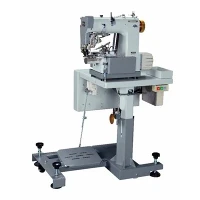
Knitwear is primarily produced using cotton and synthetic cotton yarn as raw materials. Its characteristics include softness, elasticity, breathability, sweat absorption, and comfortable wear, making it suitable for sportswear, underwear, and more. In addition to common features shared with woven clothing, knitwear possesses its own distinctive qualities.
Production Process:
Spinning → Knitting → Fabric Inspection → Cutting → Sewing → Pressing → Inspection


As a trustworthy brand in the sewing machine equipment industry, Topeagle focuses today on introducing the sewing phase. In China's knitwear industry, the sewing process and equipment primarily revolve around mid-to-high-speed lockstitch machines (commonly known as "flatbed machines"), mid-to-high-speed overlock machines (commonly known as "sergers"), and coverstitch machines. Since knitted fabrics are composed of interconnected loops, the edges of cut fabric pieces are prone to unraveling. Therefore, it's essential to first secure the fabric edges using overlock stitches before proceeding to sewing on flatbed machines and other sewing processes. Flatbed and overlock machines stand as the primary machine types for sewing knitwear. During the sewing process, the following key points should be noted:
◆Stitching: Due to the stretchiness of knitted fabrics both vertically and horizontally and the tendency for looped edges to unravel, stitches for knitwear should fulfill the following requirements:
(1) Stitches should possess the necessary stretchiness and strength that match knitted fabrics.
(2) Stitches should prevent the loops in the fabric from unraveling.
(3) Stitch density should be appropriately controlled. For thicker fabrics, flatbed machine stitches are set at a density of 9-10 stitches per 2 cm, while serger stitches are set at 6-7 stitches per 2 cm. For thinner fabrics, flatbed machine stitches are set at 10-11 stitches per 2 cm, and serger stitches at 7-8 stitches per 2 cm.

◆Thread: Generally, pure cotton knitted fabrics use 9.8 texes × 4 or 7.4 texes × 3 pure cotton or cotton-polyester blend threads. Synthetic knitted fabrics use 7.8 texes × 2 elastic nylon threads and 5 texes × 6 nylon threads.
Threads must meet the following quality requirements:
(1) For pure cotton threads, combed cotton threads should be used, offering higher strength and uniformity.
(2) Threads should possess a certain degree of elasticity to prevent breakage due to twisting or compression during sewing.
(3) Threads must be soft.
(4) Threads must be even and smooth, minimizing obstruction or friction in thread grooves and needle holes, which can lead to issues like breakage and uneven thread tension.
◆Needles: Sewing machine needles, also known as sewing needles or machine needles, play a pivotal role. To achieve ideal coordination between needles, fabrics, and threads, selecting appropriate needles is essential.
Are you ready to take your business to the next level? Our top-of-the-line sewing machine is just what you need. Don't hesitate - contact us now to learn more about how our machine can benefit your business.
please contact: wym@eagleco.cn