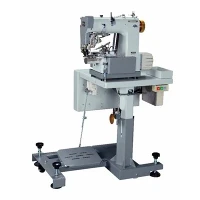
PFAFF 335 vs Dürkopp Adler 669: Which Is Better for Handbags?
The PFAFF 335 and Dürkopp Adler 669 are two well-known single-needle cylinder-arm sewing machines used for handbags, leather goods, shoes, upholstery and other three-dimensional products.
Both machines use a compound feeding system that combines bottom feed, needle feed and alternating presser-foot feed. This is often described as triple feed, unison feed or compound feed. It helps transport multiple layers evenly and reduces displacement between leather, lining, reinforcement and other materials.
However, the two machines are not positioned at exactly the same performance level.
The PFAFF 335 is a proven universal cylinder-bed machine for small leather goods, bags, leather garments and binding operations. The Dürkopp Adler 669 is a more powerful M-TYPE production machine with a longer stitch, higher presser-foot lift, stronger climbing capability and more integrated automatic functions.
Quick Answer
For professional handbag production, especially medium- to heavy-weight leather handbags, the Dürkopp Adler 669 is generally the better machine.
Choose the Dürkopp Adler 669 when you need:
Stronger performance on thick and multilayer leather
Better climbing over raised seams and cross seams
Decorative stitches up to 9 mm
Heavier needles and sewing threads
Automatic thread trimming
Automatic backtacking
Automatic presser-foot lifting
A second stitch length and second thread tension
Faster changes between different handbag operations
Choose the PFAFF 335 when you need:
A reliable universal machine for light- to medium-weight bags
A machine for wallets and small leather goods
A dedicated binding configuration
A relatively simple machine for small-batch production
Up to 6 mm stitch length
Good access to small tubular or pre-assembled components
The PFAFF 335 remains an excellent handbag sewing machine, but the Dürkopp Adler 669 offers greater capability and production flexibility.

Technical Comparison
| Specification | PFAFF 335 | Dürkopp Adler 669-180312 |
|---|---|---|
| Machine type | Single-needle cylinder-bed lockstitch machine | Single-needle cylinder-arm lockstitch machine |
| Feed system | Bottom feed, needle feed and alternating top feed | Bottom feed, needle feed and alternating top feed |
| Stitch type | 301 lockstitch | 301 lockstitch |
| Maximum sewing speed | 2,800 stitches/min | Up to 3,000 stitches/min |
| Maximum stitch length | 6 mm | 9 mm |
| Maximum alternating-foot stroke | 7 mm | 9 mm |
| Maximum foot-lifting clearance | 14 mm | Up to 20 mm |
| Cylinder-arm diameter | 51 mm | 50 mm |
| Needle system | 134-35 LR | 134-35 |
| Published needle range | Nm 80–100 | Nm 100–150 |
| Maximum published synthetic thread | 40/3 | 15/3 |
| Hook | Horizontal hook; large-hook version available | Large horizontal hook, approximately 26 mm |
| Automatic thread trimmer | Optional | Standard on Goldline configuration |
| Automatic backtacking | Optional | Standard on Goldline configuration |
| Automatic foot lift | Optional | Standard on Goldline configuration |
| Second stitch length | Not a standard feature | Integrated |
| Second thread tension | Not a standard feature | Integrated |
| Quick stroke adjustment | Not a standard feature | Integrated |
PFAFF specifies the current 335 with a maximum speed of 2,800 stitches per minute, 6 mm stitch length, 7 mm top-feed stroke, 14 mm sewing-foot clearance and a 51 mm cylinder-arm diameter. PFAFF also offers backtacking, thread trimming and automatic foot lifting as options.
Dürkopp Adler specifies the 669-180312 Goldline with a maximum stitch length of 9 mm, foot stroke of up to 9 mm, sewing-foot lift of up to 20 mm, large horizontal hook and a slim 50 mm arm. The Goldline package includes automatic basic functions, a second stitch length, a second thread tension and quick stroke adjustment.
Specifications should always be checked against the complete subclass and equipment package. A basic 669, a CLASSIC Goldline 669 and a D669 DELTA machine do not have identical features.
1. Which Machine Handles Thick Handbag Seams Better?
The Dürkopp Adler 669 has the advantage when sewing thick or uneven handbag components.
Difficult handbag operations often include:
Joining the bag body to the bottom
Sewing reinforced corners
Attaching handles
Securing shoulder straps
Sewing close to zipper ends
Crossing folded leather edges
Joining leather, lining and reinforcement
Sewing over piping or binding joints
Passing from a thin panel to a thick overlap
The PFAFF 335 provides a 7 mm alternating-foot stroke and up to 14 mm clearance under the sewing foot. These specifications are suitable for many light- and medium-weight handbags and small leather goods.
The Dürkopp Adler 669 provides a maximum alternating-foot stroke of 9 mm and foot-lifting clearance of up to 20 mm. Dürkopp Adler specifically highlights its ability to climb over material plies of different heights while reducing shortened stitches and material damage at thick sections.
This additional capacity is valuable when producing structured leather bags with reinforced bases, folded edges or multiple layers.
Winner for thick seams: Dürkopp Adler 669
2. Which Machine Produces Better Decorative Topstitching?
Both machines can produce attractive leather topstitching when correctly adjusted. However, the Dürkopp Adler 669 offers greater flexibility.
The PFAFF 335 has a maximum stitch length of 6 mm. This is sufficient for most assembly seams and many decorative handbag stitches.
The Dürkopp Adler 669 provides a maximum stitch length of 9 mm. The longer adjustment range is useful for:
Premium leather handbag topstitching
Long decorative stitches
More visible seam designs
Thicker topstitching thread
Shoulder straps and handles
Bag flaps and external panels
A 9 mm stitch is not required for every handbag. Small components and tight curves normally require a shorter stitch. However, the wider adjustment range allows a factory to produce more styles with one machine.
The 669 Goldline also includes an integrated second stitch length. An operator can use one stitch length for normal assembly and activate another for decorative sections or difficult material transitions.
Winner for decorative topstitching: Dürkopp Adler 669
3. Which Machine Is Better for Coarse Thread?
The Dürkopp Adler 669 has a broader published needle and thread capacity.
PFAFF lists the current 335 with:
Needle system 134-35 LR
Needle sizes Nm 80–100
Synthetic thread up to 40/3
Dürkopp Adler lists the 669-180312 with:
Needle system 134-35
Needle sizes Nm 100–150
Synthetic thread up to 15/3
These figures indicate that the 669 is designed to accommodate heavier needles and sewing threads.
This can be important for:
Visible decorative seams
Thick genuine leather
Handles and straps
Reinforced bag sections
Products requiring a stronger seam appearance
The maximum usable thread also depends on the hook, needle plate, presser feet, feed dog, needle point, material and machine adjustment. A sewing test should be carried out before selecting the final configuration.
Winner for coarse thread: Dürkopp Adler 669
4. Which Machine Is Better for Small and Difficult-to-Reach Areas?
This category is very close.
The PFAFF 335 has a cylinder-arm diameter of 51 mm, while the Dürkopp Adler 669 has a diameter of approximately 50 mm. Both are designed for tubular, curved and pre-assembled products.
Typical handbag operations include:
Sewing inside a partially assembled bag
Closing side gussets
Attaching circular or curved bottoms
Sewing around small openings
Working close to raised edges
Stitching narrow tubular handles
Sewing difficult internal corners
The 669 combines its slightly slimmer arm with higher lift and stronger feeding performance. This makes it particularly suitable for difficult-to-access areas that also contain thick material transitions.
The PFAFF 335 remains highly capable when the products are lighter and the sewing space is limited.
Winner for difficult areas: Slight advantage to Dürkopp Adler 669
5. Which Machine Is Better for Binding?
For a dedicated binding operation, the answer depends on the exact configuration rather than only the machine class.
PFAFF offers the 335-17/01, a version developed specifically for assembly and binding operations. It uses a moving binder designed to produce neat binding around both inside and outside curves. The large-hook version also provides approximately 40% more bobbin capacity than the standard hook.
The Dürkopp Adler 669 is also highly suitable for binding. Its bottom-feed stroke can be deactivated for low-tension edge binding, and the machine can be converted quickly between topstitching and binding applications. Dürkopp Adler identifies this flexibility as a special feature of the 669.
For binding handbags, buyers should confirm:
Binding material
Finished binding width
Tape inlet width
Straight or curved binding
Inside and outside curves
Material thickness
Binder position
Needle plate and feed-dog set
Presser-foot configuration
A properly configured PFAFF 335-17/01 may outperform a standard 669 that does not have the correct binding equipment. A correctly equipped 669, however, provides greater flexibility when the same production line must also perform assembly and decorative stitching.
Winner for dedicated binding: PFAFF 335-17/01
Winner for mixed binding and assembly operations: Dürkopp Adler 669
6. Which Machine Is More Productive?
The Dürkopp Adler 669 Goldline is the stronger production platform.
Its integrated functions include:
Automatic thread trimming
Automatic backtacking
Automatic presser-foot lifting
Second stitch length
Second thread tension
Quick foot-stroke adjustment
Automatic speed limitation according to foot stroke
Direct-drive motor
Integrated sewing light
Maintenance indicator
These functions reduce manual handling and allow the operator to adapt quickly when moving between different handbag components.
For example, the operator can:
Use a shorter stitch for internal assembly.
Switch to a longer second stitch for external topstitching.
Activate additional thread tension when crossing a thick section.
Increase the presser-foot stroke for a raised seam.
Automatically reduce speed during difficult operations.
Finish the seam with automatic backtacking and thread trimming.
PFAFF offers thread trimming, backtacking and automatic foot lifting as optional equipment for the 335. The actual functions therefore depend on the ordered configuration.
For small workshops, the additional automation may not be essential. For repeated handbag production, it can significantly improve consistency and operator efficiency.
Winner for productivity: Dürkopp Adler 669
7. Which Machine Is Easier to Use and Maintain?
The PFAFF 335 has an advantage for customers who prefer a simpler, more traditional machine.
PFAFF describes the 335 as having a rugged, durable and easy-to-maintain machine concept.
A basic or mechanically configured 335 may be suitable for:
Small leather workshops
Sample rooms
Handcrafted bag production
Repairs and alterations
Low-volume production
Operators who do not require extensive automation
The 669 Goldline contains more electronic and pneumatic functions. These features improve flexibility and productivity but require correct installation, air supply, operator training and technical support.
The best machine is not necessarily the one with the most functions. It is the machine whose configuration matches the production environment.
Winner for simplicity: PFAFF 335
Comparison by Handbag Application
| Handbag Product or Operation | Recommended Machine |
|---|---|
| Wallets and small leather goods | PFAFF 335 |
| Lightweight leather handbags | Either machine |
| Canvas and textile bags | PFAFF 335 |
| Medium-weight leather handbags | Dürkopp Adler 669 |
| Structured genuine-leather bags | Dürkopp Adler 669 |
| Thick bag bottoms | Dürkopp Adler 669 |
| Handles and shoulder straps | Dürkopp Adler 669 |
| Reinforced corners | Dürkopp Adler 669 |
| Long decorative topstitching | Dürkopp Adler 669 |
| Coarse-thread topstitching | Dürkopp Adler 669 |
| Dedicated edge binding | PFAFF 335-17/01 |
| Binding plus general assembly | Dürkopp Adler 669 |
| Small-batch handcrafted production | PFAFF 335 |
| High-mix professional handbag production | Dürkopp Adler 669 |
| Production requiring automatic functions | Dürkopp Adler 669 |
PFAFF 335 Advantages for Handbag Production
The PFAFF 335 remains a practical choice because it offers:
Proven unison-feed performance
A narrow cylinder arm
Good control on light- and medium-weight leather
Reliable sewing over moderate cross seams
Suitability for bags and small leather goods
A specialized binding version
Optional automation
Straightforward operation and maintenance
It is particularly suitable for factories and workshops producing wallets, pouches, lightweight handbags and bound leather products.
Dürkopp Adler 669 Advantages for Handbag Production
The Dürkopp Adler 669 offers:
Up to 9 mm stitch length
Up to 9 mm alternating-foot stroke
Up to 20 mm foot lift
A slim 50 mm cylinder arm
A large horizontal hook
Strong performance over thick seams
Heavier needle and thread capacity
Integrated second stitch length
Integrated second thread tension
Quick stroke adjustment
Automatic trimming, backtacking and foot lifting
Flexible conversion between topstitching and binding
These characteristics make it better suited to professional production of structured, medium- and heavy-weight leather handbags.

Final Verdict: Which Is Better for Handbags?
The Dürkopp Adler 669 is the better overall machine for professional handbag manufacturing.
It offers more capacity for thick leather, larger material transitions, coarse thread, long decorative stitches and automated production. It is particularly suitable for premium leather handbags, structured bags, handles, reinforced corners, bag bottoms and other demanding operations.
The PFAFF 335 remains the better-value practical option for lighter handbags, wallets, small leather goods and dedicated binding work. It is also suitable for workshops that prefer a simpler machine and do not require all the automatic functions of the 669 Goldline.
The correct conclusion is therefore:
For professional production of medium- to heavy-weight leather handbags, choose the Dürkopp Adler 669. For light- to medium-weight bags, small leather goods and specialized binding operations, the PFAFF 335 remains an excellent choice.
Frequently Asked Questions
Is the PFAFF 335 suitable for making handbags?
Yes. PFAFF officially recommends the 335 for bags, leathercraft articles, small leather goods and tubular or pre-assembled products. Its unison-feed system, 51 mm cylinder arm and 7 mm top-feed stroke make it suitable for many light- and medium-weight handbag operations.
Is the Dürkopp Adler 669 suitable for luxury leather bags?
Yes. The 669 is particularly suitable for decorative stitching, assembly and binding on leather goods and difficult three-dimensional components. Its 9 mm stitch length, coarse-thread capacity and strong climbing performance are valuable for premium leather handbags.
Which machine is better for thick leather?
The Dürkopp Adler 669 is generally better for thicker leather and multilayer assemblies because it provides a higher presser-foot stroke, greater foot lift and a heavier published needle and thread range.
Which machine has the longer stitch?
The PFAFF 335 provides a maximum stitch length of 6 mm. The Dürkopp Adler 669-180312 provides up to 9 mm.
Which machine is better for bag binding?
The PFAFF 335-17/01 is a strong choice for a dedicated binding workstation. The Dürkopp Adler 669 is more flexible when the same machine must alternate between binding, assembly and decorative topstitching.
Does the PFAFF 335 have an automatic thread trimmer?
Automatic thread trimming is available as an option on the PFAFF 335. It should not be assumed to be included unless the full machine configuration confirms it.
Does the Dürkopp Adler 669 include automatic functions?
The 669 CLASSIC Goldline includes automatic thread trimming, automatic backtacking and automatic presser-foot lifting, together with a second stitch length, second thread tension and quick stroke adjustment. Other 669 configurations may differ.
Can one cylinder-arm machine complete an entire handbag?
A cylinder-arm machine can perform many assembly, topstitching and binding operations, but a professional handbag production line may also require flat-bed, post-bed, skiving, splitting, gluing, edge-folding and other specialized machines.
How to Select the Correct Machine
Before choosing between the PFAFF 335 and Dürkopp Adler 669, provide the supplier with:
Photos of the finished handbag
Leather type and thickness
Number of material layers
Thickest seam section
Thread and needle size
Required stitch length
Minimum sewing radius
Binding width and material
Required automatic functions
Production quantity
Voltage and frequency
Destination country
A sewing test with the actual leather, reinforcement, lining and thread is the most reliable way to confirm the correct model and sewing equipment.
DAPSEW Multi-Brand Sourcing Support
DAPSEW is an independent multi-brand industrial sewing machine supplier serving customers worldwide.
We provide legally sourced industrial sewing machines from leading international brands and help customers compare models according to their products, materials, production volume and budget.
For handbag manufacturers comparing the PFAFF 335 and Dürkopp Adler 669, DAPSEW can assist with:
Model and subclass selection
Machine configuration comparison
Binding and topstitching equipment
Motor and voltage selection
Sewing sample evaluation
Spare-parts sourcing
Export packing
International shipping
Contact DAPSEW with your handbag photos, leather specifications and sewing requirements to receive a suitable machine recommendation.
Keyword: PFAFF 335 vs Dürkopp Adler 669, handbag sewing machine, leather bag sewing machine, cylinder arm sewing machine for bags, PFAFF 335 sewing machine, Dürkopp Adler 669, industrial sewing machine for handbags, triple feed cylinder bed sewing machine
Trademark Notice: PFAFF and Dürkopp Adler are trademarks belonging to their respective owners. DAPSEW is an independent multi-brand industrial sewing machine supplier and does not claim official authorization unless expressly stated.