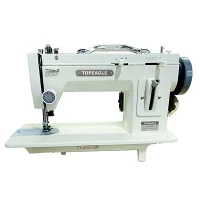
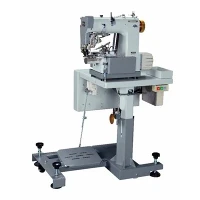
The compound feed thick material lockstitch machine is a versatile lockstitch machine with a prominent feature of employing a large shuttle hook thread loop mechanism, along with an integrated upper and lower feed system and alternating presser foot lifting mechanism. Due to its robust stitching capacity for thick fabrics, excellent layering performance, and stable backstitch formation, it finds extensive application in producing medium to heavy-weight materials like leather and canvas.
Below, I will briefly explain the routine adjustments for this machine's common issues:

(1) Needle Position.
When the needle reaches its lowest point, the center of the needle hole should align with the outer surface of the shuttle hook. For thicker fabrics, the center of the needle hole can be lowered by approximately 0.5 millimeters.
(2) Needle and Shuttle Synchronization.
The standard synchronization relationship involves the needle moving down to its lowest position and then ascending about 2.5 millimeters. At this point, the tip of the shuttle hook should align with the needle's centerline, with the shuttle hook tip positioned about 1.2 to 1.5 millimeters above the upper edge of the needle hole. Additionally, the gap between the bottom of the needle notch and the shuttle hook tip should be within 0 to 0.05 millimeters.
(3) Feed Dog Position of Compound feed industrial sewing machine.
① The standard position involves adjusting the feed dog to its maximum setting. When the front end of the feed dog is close to the front side of the needle plate groove, there should be a 1.5-millimeter gap between the front end of the feed dog and the plane of the needle plate groove. After adjustments, you can set the desired feed dog position.
② When the feed dog reaches its highest point, it should be positioned 0.8 to 1.2 millimeters above the needle plate plane. For thicker fabrics, you can adjust it slightly higher by about 1.5 millimeters. The feed dog is generally in a horizontal position, but it should be adjusted when sewing conditions require an inclination.
(4) Feed Synchronization.
The standard position involves the feed dog moving to be level with the needle plate plane, and the needle tip should also be aligned with the surface of the needle plate. For thinner fabrics, the needle tip can be slightly lower than the needle plate plane by around 0.5 millimeters.
(5) Upper Feed Mechanism Adjustment.
In general, the upper feed should be synchronized with the lower feed. However, special situations might arise during sewing. Depending on the varying friction coefficients of different fabrics and the requirements of the sewing process, the swing pressure foot slide block and swing pressure foot axis should be adjusted to modify the center distance. Increasing the center distance will increase the upper feed while reducing it will decrease the upper feed. Additionally, during actual operations, you can slightly delay the upper feed time compared to the lower feed time according to specific requirements.
(6) Presser Foot Alternating Lifting Mechanism Adjustment.
For sewing medium-thick materials, the swing pressure foot lift is within 5.5 millimeters, and the small pressure foot lift is around 3.5 millimeters. With other mechanisms unchanged, the sum of the two pressure foot lifts remains constant. However, you can alter the total lift of the swing pressure foot and small pressure foot by adjusting the eccentric wheel connecting rod screw and the center distance of the pressure foot up/down axis. Reducing the center distance increases the lift of the swing pressure foot and small pressure foot, and vice versa, reducing the lift.
Note: After adjustments are completed, slowly rotate the handwheel and check for any collisions. Once everything is in order, you can proceed with usage. The clearance between the swing pressure foot and the pressure foot in the front-to-back direction is generally maintained at around 1.5 millimeters. However, for large stitch lengths, the swing pressure foot's front-to-back travel might be larger, and vice versa. Therefore, during actual operations, appropriate adjustments should be made based on the stitching needle distance.
If you're interested in purchasing various models of Compound feed industrial sewing machines, feel free to contact us at wym@eagleco.cn or search within the search box, or browse the relevant products in the below section of our website.