360° Rotating Head vs. Conventional Template Sewing Machines: How to Choose?
CNC template sewing machines are widely used for repetitive stitching operations in industrial sewing production. They follow programmed sewing paths while holding materials in customized templates, helping improve stitching consistency and reduce manual positioning.
For heavy-duty materials and complex sewing patterns, the choice between a conventional fixed-head template sewing machine and a 360° rotating head template sewing machine can be particularly important.
1. What Is a 360° Rotating Head Template Sewing Machine?
A 360° rotating head template sewing machine allows the sewing head to rotate automatically according to the programmed sewing path.
Unlike conventional fixed-head machines, which maintain a fixed sewing-head orientation, rotating-head machines can adjust the sewing direction as the template moves.
This design helps maintain a suitable sewing orientation around curves, corners and changes in stitching direction.
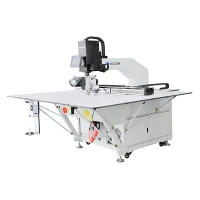
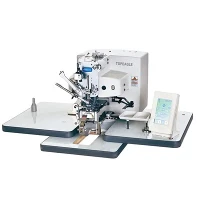
The TOPEAGLE TPS-1821-10060-1SD is an example of this configuration, featuring a 360° rotating sewing head with 80 mm of vertical lifting travel.
2. What Are the Main Differences?
| Feature | Conventional Fixed-Head Machine | 360° Rotating Head Machine |
|---|---|---|
| Sewing Head | Fixed orientation | Automatically rotates |
| Sewing Direction | Depends on programmed X-Y movement | Head orientation follows programmed path |
| Complex Curves | May require reverse-direction stitching | Helps reduce reverse-direction stitching |
| Sewing Mechanism | Generally simpler | Additional rotating mechanism |
| Typical Use | Repetitive patterns and standard sewing paths | Complex patterns and directional stitching requirements |
Both machine types can provide consistent programmed sewing. The appropriate choice depends on the material, sewing pattern and production requirements.
3. Why Is Sewing-Head Rotation Important for Heavy Materials?
Heavy-duty materials such as leather and multilayer bag components can be more demanding to sew than lightweight fabrics.
When a sewing pattern includes frequent direction changes, the relationship between the needle, presser foot and material becomes important.
A rotating sewing head can help maintain a more consistent sewing orientation along the programmed path, reducing the need for reverse-direction stitching.
However, rotating-head technology does not automatically mean that a machine can sew every thick material. Actual sewing capability still depends on the needle, thread, rotary hook, presser-foot system and material structure.
4. Key Features to Consider When Selecting a Heavy-Duty Template Sewing Machine
Sewing Area
Choose a sewing area that accommodates the complete pattern and template.
For example, the TOPEAGLE TPS-1821-10060-1SD provides a standard sewing area of 1000 × 600 mm. Customized sewing areas can also be discussed.
Rotating and Lifting Sewing Head
The TPS-1821-10060-1SD features 360° sewing-head rotation and 80 mm lifting travel, providing flexibility for programmed stitching operations.
Heavy-Duty Sewing Mechanism
The machine uses a mechanical inner presser foot and an XL rotary hook with a 26 mm bobbin diameter.
Material compatibility should be confirmed according to the actual sewing samples.
CAD Pattern Programming
CAD-based programming can simplify pattern preparation. The TPS-1821-10060-1SD supports converting DXF, AI and PLT files into machine-compatible sewing programs through programming software.
Template Recognition
RFID template recognition helps identify compatible sewing templates, reducing manual program selection.
Worktable Design
A foldable worktable can be useful for machine transportation and space management.
5. Example: TOPEAGLE TPS-1821-10060-1SD
The TPS-1821-10060-1SD is a heavy-duty CNC template sewing machine designed for programmable stitching applications.
Its main specifications include:
| Parameter | Specification |
|---|---|
| Model | TPS-1821-10060-1SD |
| Sewing Head | 360° Rotation, 80 mm Lift |
| Standard Sewing Area | 1000 × 600 mm |
| Maximum Sewing Speed | 2,500 rpm |
| Maximum Stitch Length | 12.7 mm |
| Maximum Stitches per Pattern | 100,000 |
| Rotary Hook | XL Hook, 26 mm Bobbin Diameter |
| Needle System | DP×17 |
| Template Recognition | RFID |
| Control Panel | 10-Inch Touchscreen |
| X-Y Drive | Lead Screw / Synchronous Belt |
The machine can be considered for suitable leather goods, bag panels and other heavy-duty template sewing operations.
6. Which Machine Should You Choose?
A conventional fixed-head template sewing machine may be sufficient when sewing patterns are relatively simple and the materials can be handled consistently without sewing-head rotation.
A 360° rotating head template sewing machine is worth considering when the sewing process involves complex curves, frequent changes in stitching direction or heavy-duty materials requiring more controlled sewing orientation.
Before selecting a machine, evaluate:
Material type, thickness and number of layers
Required sewing area
Sewing pattern and direction changes
Needle and thread specifications
Template and clamping requirements
Production capacity
Frequently Asked Questions
Does a 360° rotating head machine eliminate reverse stitching?
The rotating head is designed to reduce the need for reverse-direction stitching by adjusting sewing-head orientation. The actual result depends on the programmed pattern and sewing configuration.
Can a rotating head template machine sew leather?
Some heavy-duty models are designed for leather applications. Material thickness, thread, needle and presser-foot compatibility should be verified before production.
Can CAD drawings be used for template sewing?
Yes. Depending on the machine software, CAD files can be converted into compatible sewing programs.
Is a rotating head machine always better than a fixed-head machine?
No. Fixed-head machines can be suitable for many repetitive sewing operations. Rotating-head machines offer additional flexibility where sewing direction and pattern complexity justify the added mechanism.
Conclusion
Choosing the right CNC template sewing machine requires more than comparing sewing speed and working area.
For heavy-duty materials and complex stitching paths, a 360° rotating sewing head can provide additional flexibility in sewing-direction control.
TOPEAGLE supplies industrial template sewing machines and provides application-based machine selection support.
For the TPS-1821-10060-1SD, customers can share material samples, sewing patterns and production requirements to evaluate a suitable configuration.
Need Help Choosing a Template Sewing Machine?
Send TOPEAGLE your sewing material details, pattern drawings and required sewing area. Our team can help you evaluate a suitable machine configuration.
Please include your sewing application, material specifications, required quantity and destination country.
Send Your Sewing RequirementsDirect email to TOPEAGLE Sales: sale@eagleco.cn