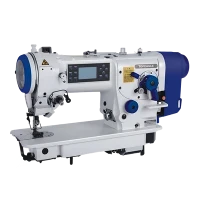
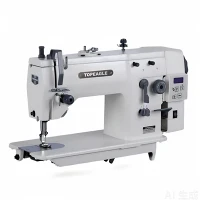
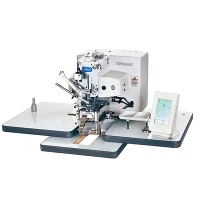
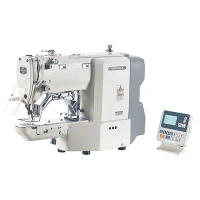
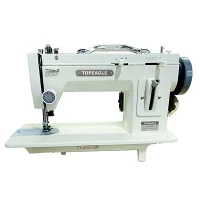
Lockstitch Sewing Machine is an industrial sewing machine that uses needles and shuttle to form lock stitch. It can sew two or more layers of sewing material or sew a decorative stitches on the sewing material. It is the most basic type of industrial sewing machine. The double thread lock stitch sewn by the utility model is the most firm one among all kinds of stitches, so it can be used for a wide range of purposes. It can sew fabrics such as silk, hemp, cotton, wool, and chemical fiber, as well as clothing, wearing articles, bedding, bags, tablecloths, curtains, etc. made of soft leather and artificial leather, and can sew two layers of silk to multi-layer soft leather.
The Lockstitch Sewing Machine is composed of a head, a platen, and a frame. The clutch motor is installed on the bottom of the platen. Its transmission wheel is connected with the upper wheel of the head with triangular tape. Step on the pedal on the frame and control the tightness of the clutch to obtain different sewing speeds.

The machine head completes the double thread lock stitch jointly by the cloth pricking, thread take-up, and thread hook mechanism: the needle pitch adjustment, automatic feeding and reverse sewing mechanism can realize the continuous stitch sewing with set needle pitch; the stitch and stitch are improved by the adjustment and release device of sewing material pressure and sewing tension. In order to adapt to the high-speed operation of the main shaft 6000r / min and shuttle shaft 12000r / min, the head is equipped with an oil supply impeller pump and oil suction plunger pump to lubricate all moving components.
The process of a lockstitch completed by a lockstitch sewing machine is to first punch a hole in the sewing material, guide the needle and thread through the sewing material, then make it bypass the shuttle under the sewing material, interweave and tighten the needle and thread with each other in the sewing material, and finally move the sewing material forward or backward for a certain distance in the new sewing material
Punch and lead at the position. After the second process, a stitch is completed.