Button Attaching vs. Button Neck Wrapping: What Is the Difference?
Button attaching is an essential operation in garment manufacturing. However, sewing a button directly onto fabric is not always sufficient, especially for suits, jackets and coats made from thicker materials.
For these garments, button neck wrapping helps create the necessary clearance between the button and the fabric, making the garment easier to fasten while maintaining a neat appearance.
Understanding the difference between ordinary button attaching and button neck wrapping can help garment manufacturers select the appropriate sewing equipment.
1. What Is Button Attaching?
Button attaching is the process of securing a button to fabric using sewing thread.
Conventional industrial button sewing machines are commonly used for attaching two-hole and four-hole flat buttons to shirts, trousers, uniforms and other garments.
For lightweight materials, direct button attachment may provide sufficient clearance for fastening.
However, thicker garments often require additional space between the button and the fabric.
2. What Is Button Neck Wrapping?
Button neck wrapping is the process of wrapping thread around the stitches beneath an attached button to form a raised thread neck.
This wrapped neck provides controlled spacing between the button and garment surface.
Main benefits include:
Improved fastening clearance for thicker fabrics
A more consistent button-neck height
Neater button attachment on suits and coats
Controlled thread wrapping beneath the button
Button neck wrapping is particularly useful for tailored garments where appearance and fastening performance are important.
3. Button Attaching vs. Button Neck Wrapping
| Feature | Button Attaching | Button Attaching with Neck Wrapping |
|---|---|---|
| Main Operation | Secures button to fabric | Secures button and forms a wrapped thread neck |
| Button Clearance | Depends on sewing setup | Controlled by neck-wrap height |
| Typical Applications | Shirts, trousers, uniforms | Suits, jackets, coats |
| Thread Wrapping | Not necessarily required | Included |
| Machine Selection | Standard button sewing machine | Button attaching and neck-wrapping machine |
The correct process depends on garment thickness, button construction and the required fastening clearance.
4. Why Is Neck-Wrap Height Important?
If a button is attached too closely to a thick garment, fastening it through the buttonhole may be difficult.
Excessive clearance, on the other hand, may result in a loose or untidy appearance.
A programmable button neck-wrapping machine allows the operator to adjust the neck height according to garment construction.
For example, the TOPEAGLE TBA-289 provides a programmable neck-wrap height of 0 or 1.5–10.0 mm, adjustable in 0.1 mm increments.
The correct setting should be determined by the garment thickness, button type and desired appearance.
5. How Does an Automatic Button Attaching and Neck-Wrapping Machine Work?
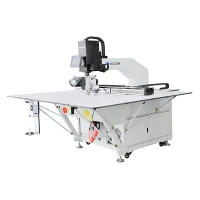
An automatic button attaching and neck-wrapping machine combines button attachment and thread wrapping within a programmed sewing cycle.
The general process involves:
Positioning the garment and button
Attaching the button with the programmed stitches
Forming the required button-neck height
Wrapping thread around the button neck
Completing the programmed sewing cycle
The TOPEAGLE TBA-289 uses a computer-controlled, single-thread chainstitch system with electronic thread-tension control.
The machine allows different tension settings for button attaching and neck wrapping, helping operators achieve repeatable results.
The operator still positions the garment between button locations; automatic cycle control should not be confused with fully automatic garment handling.
6. Which Button Types Can Be Sewn?
Depending on the installed attachments and sewing configuration, the TBA-289 can handle:
Two-hole and four-hole flat buttons
Shank buttons
Marble buttons
Stay buttons
Counter buttons
Its published button-size ranges are:
| Button Operation | Diameter Range |
|---|---|
| Button attaching without neck wrapping | 8–38 mm |
| Button attaching with neck wrapping | 8–32 mm |
| Counter-button attaching | 8–25 mm |
Button thickness, hole spacing and the installed button carrier must also be checked.
7. When Should Garment Manufacturers Consider an Automatic Neck-Wrapping Machine?
A programmable button attaching and neck-wrapping machine may be suitable when production involves:
Men's and women's suits
Double-breasted jackets
Coats and blazers
Uniforms and formalwear
Garments requiring different button types
Repeated production requiring consistent neck-wrap height
The TBA-289 also provides programmable sewing patterns and cycle sewing for garment styles requiring several button operations.
8. How to Choose the Right Button Sewing Machine
Before selecting a machine, confirm the following:
Button specifications: Button diameter, number of holes, hole spacing and thickness.
Garment construction: Fabric type, number of layers and thickness around the button position.
Neck-wrapping requirements: Whether a wrapped neck is needed and the required height.
Counter-button requirements: Whether a supporting button is required on the reverse side.
Production process: Required button types, sewing sequence and daily production requirements.
Providing actual buttons and garment samples is recommended when confirming machine configuration.
Frequently Asked Questions
Is button neck wrapping necessary for every garment?
No. Lightweight garments may use direct button attachment. Neck wrapping is particularly useful where additional fastening clearance is needed.
Can a neck-wrapping machine also attach buttons without wrapping?
Yes. The TBA-289 supports suitable button-attaching operations with the neck-wrap height set to zero.
What is the maximum neck-wrap height of the TBA-289?
The published adjustable range is 0 or 1.5–10.0 mm.
Can the TBA-289 sew large buttons?
It supports buttons up to 38 mm in diameter without neck wrapping and up to 32 mm with neck wrapping, subject to compatible attachments and button specifications.
Does automatic button sewing mean the entire garment is automatically positioned?
No. The TBA-289 automatically controls the programmed sewing cycle, while the operator normally positions the garment.
Conclusion
Button attaching and button neck wrapping serve different garment construction requirements.
For suits, jackets and coats, a controlled thread neck can improve button clearance and provide a more consistent finished appearance.
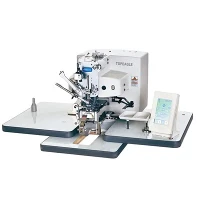
The TOPEAGLE TBA-289 Automatic Button Attaching & Neck-Wrapping Machine combines these operations with programmable settings and electronic thread-tension control.
For machine selection, customers should provide their button specifications, garment materials and required sewing operations.
Need Help Choosing a Button Attaching Machine?
Looking for a suitable machine for button attaching and neck wrapping? Send TOPEAGLE your button specifications, garment materials and production requirements for machine selection support.
Please include your button type, diameter, required neck-wrap height, quantity and destination country.
Send Your Button Sewing RequirementsDirect email to TOPEAGLE Sales: sale@eagleco.cn