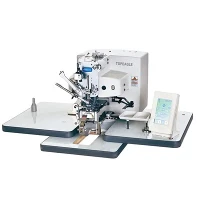
How to Choose an Extra Heavy-Duty Compound Feed Sewing Machine
An extra heavy-duty compound feed sewing machine is suited to flat assemblies that combine thick materials, multiple layers or bulky seams. To choose the right machine, check two things first: whether the feed system can handle your thickest seam, and whether the workpiece can fit and turn to the right of the needle.
The TOPEAGLE TCF-243 has a working space of 420 × 180 mm. The TCF-246 has a working space of 635 × 180 mm, providing an additional 215 mm of horizontal clearance. That extra room matters when the operator needs to guide a large panel or reach a seam farther in from the edge.
What Does Compound Feed Do?
Compound feed, also called unison feed, coordinates the movement of the feed dog, needle and walking presser foot. This helps advance multiple layers together and reduces the risk of one layer shifting ahead of another.
For example, when sewing webbing onto a canvas panel, the seam may cross from the panel itself onto a folded reinforcement. The operator needs to keep the layers aligned while the presser foot moves over the change in thickness. Compound feed helps control the material through that transition. A sample test is the best way to check how the machine handles the actual seam, especially at folded edges, corners and overlapping layers.
TCF-243 vs TCF-246: Which Working Space Do You Need?
Both models are flat-bed compound feed lockstitch machines with a large shuttle hook. The flat bed supports workpieces that can be laid out, guided and turned on the table.
| Model | Working space | When to consider it |
|---|---|---|
| TCF-243 | 420 × 180 mm | For heavy flat assemblies that fit comfortably to the right of the needle, such as canvas hems, luggage reinforcements and webbing attached near a panel edge. |
| TCF-246 | 635 × 180 mm | For wider panels, seams farther from the edge, or bulky workpieces that need more room to turn during sewing. |
To compare the two, position your workpiece along its actual seam line and look at how much material will sit to the right of the needle. Then check what happens at the tightest turn. A large panel with an edge seam may fit the TCF-243 comfortably if most of the material stays to the left. The same panel may benefit from the TCF-246 when sewing an internal reinforcement or turning a bulky corner.
Want help choosing between the two models?
Send us your material, maximum seam thickness and a photo showing the seam location.
TOPEAGLE can help you compare the working space and select a suitable configuration.
What Should You Check Before Ordering?
Maximum seam thickness. Measure the thickest point the needle will pass through, including hems, folded edges and reinforcement layers.
Material and thread. Specify the material, number of layers and intended thread size. For mixed assemblies, list each material in the seam.
Space to guide and turn the workpiece. Include the panel dimensions, seam location and a photo or sketch of the tightest turn.
Motor and power supply. A servo motor is optional for the TCF-243 and TCF-246. Confirm the desired configuration and local voltage when requesting a quotation.
Frequently Asked Questions
Is a 635 mm long arm better for sewing tents and canvas covers?
It can make large or stiff panels easier to handle when the seam sits well inside the panel or the workpiece needs to turn under the arm. For straight hems near the edge, 420 mm may be enough. Use the seam position and turning space to make the decision.
Does a 635 × 180 mm working space indicate how thick the machine can sew?
Working space describes the clearance for handling the workpiece. Sewing capability depends on the actual material stack, thread and seam construction. Check the thickest seam separately.
Can the TCF-243 and TCF-246 be used for leather as well as canvas and webbing?
These models can be considered for thick leather and mixed-material assemblies that can be supported on a flat bed. For shaped items with tight access, check whether the workpiece can lie flat and turn freely around the needle before choosing a machine.