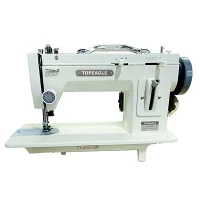
Generally, after 2 years of Overlock Sewing Machine operation, more comprehensive maintenance must be carried out. The second-class maintenance of the sewing machine is divided into disassembly, cleaning, overhaul, assembly, and commissioning.
1) Disassembly

The disassembly of the overlock sewing machine should follow the principle from outside to inside. Generally, the disassembly can be carried out according to the following steps:
Foot pressing mechanism Feeding mechanism Needle bending mechanism Lower cutter assembly Needle rod threading assembly Drive assembly Upper tool carrier assembly Oil pump assembly Main shaft Pin base adjustment mechanism.
It must be noted that different equipment may be disassembled in different steps and according to the model specifications.
Before disassembly, it is important to determine the relationship and relative position of the agencies, components, and parts. During disassembly, the components are arranged according to their classification so as to avoid installation errors and improve installation speed.
For parts that do not need to be disassembled, do not disassemble to avoid reducing the accuracy of the mating between the parts. When disassembling tight fit parts, use special tools as far as possible to avoid hitting parts directly and prevent damage to parts caused by disassembly.
2) Cleaning
Clean disassembled components and parts with kerosene or detergent and place them in categories to avoid inspection and maintenance.
3) Overhaul

Check the cleaned components and parts one by one and repair or replace them according to the severity of the problem found. The main inspection items for each component are as follows:
Main shaft mechanism: Check the clearance between the main shaft and sleeve, spindle, and bearing. If the clearance is too large to be solved by adjustment, the sleeve or bearing should be replaced.
Needle rod mechanism: When the needle rod is at the lowest position, check the gap between the needle rod and the sleeve. If the gap is too large, the needle rod or sleeve can be replaced. Check the upper and lower looseness of the needle rod. If the range of upper and lower looseness exceeds the specified value (high-speed overlock sewing machine 0.3mm, medium-speed machine 0.8mm), the chain links and chain pins need to be replaced. Check the wear of the connecting parts in the needle bar mechanism. If the wear is not serious, it can be repaired with a fine file or sandpaper. If the wear is serious, it needs to be replaced. Check the stroke of the needle bar mechanism and adjust it according to the sewing requirements.
Needle Bending Mechanism: Check the wear condition of each connecting part of the needle bending mechanism, repair slightly worn parts, and replace seriously; Check the reciprocating swing amplitude of the upper and lower bent pins. If the swing amplitude is too large, the shaft, connecting rod, and connecting rod screw of the bent pin holder need to be replaced. Check the degree of looseness of the chain hook needle in all directions. If looseness is serious, it means that the related parts of the chain hook needle are worn seriously. It is necessary to consider replacing parts such as chain hook needle driven crank, chain hook needle connecting rod, and chain hook needle-moving slider.
Feeding mechanism: Check the wear of connecting rods and cams, connecting rods and cranks, lifting slide, feeding dog, pressing, foot pressing base plate, etc., repair slight wear, and replace severe wear.
Cutting mechanism: inspect the wear of the cutter holder and upper and lower cutters, repair the wear of the cutter holder, and grind the blades, and replace them if they can not be repaired.
Oil circuit: Check the oil circuit, oil hole, and oil pipe for smoothness, connection, and integrity.
Motor: check the fixed condition, running sound and temperature of the motor, the fit and running condition of the clutch, the link and intact condition of the motor, and lubricate the bearings of the motor with butter.
4) Assembly and commissioning

Install the agencies, components, and parts in the reverse order of disassembly according to the principle from the inside out, then adjust according to the positioning standards and commissioning requirements of the agencies. After all the adjustments have been made, refuel the machine, make it run manually, confirm that the machine is working properly, then connect the power supply for the test seam.